 PixelCircles
Nether Portal Calculator
To line up a Nether portal, divide the Overworld X and Z by 8 and round down: Overworld X 1000 is Nether X 125, and Nether X 125 is Overworld X 1,000. This nether portal calculator converts coordinates both ways, keeps Y as it is, and counts the obsidian for any frame from 4 × 5 to 23 × 23: 14 blocks for the smallest frame, 10 without its corners, 88 for the largest. Works for Java and Bedrock. Download a .litematic schematic and import it into Minecraft Java with Litematica — build over the hologram in survival or paste it in creative.
Overworld X 1,000 to 1,007 and Z -2,000 to -1,993 all lead to Nether X 125, Z -250.
14 obsidian
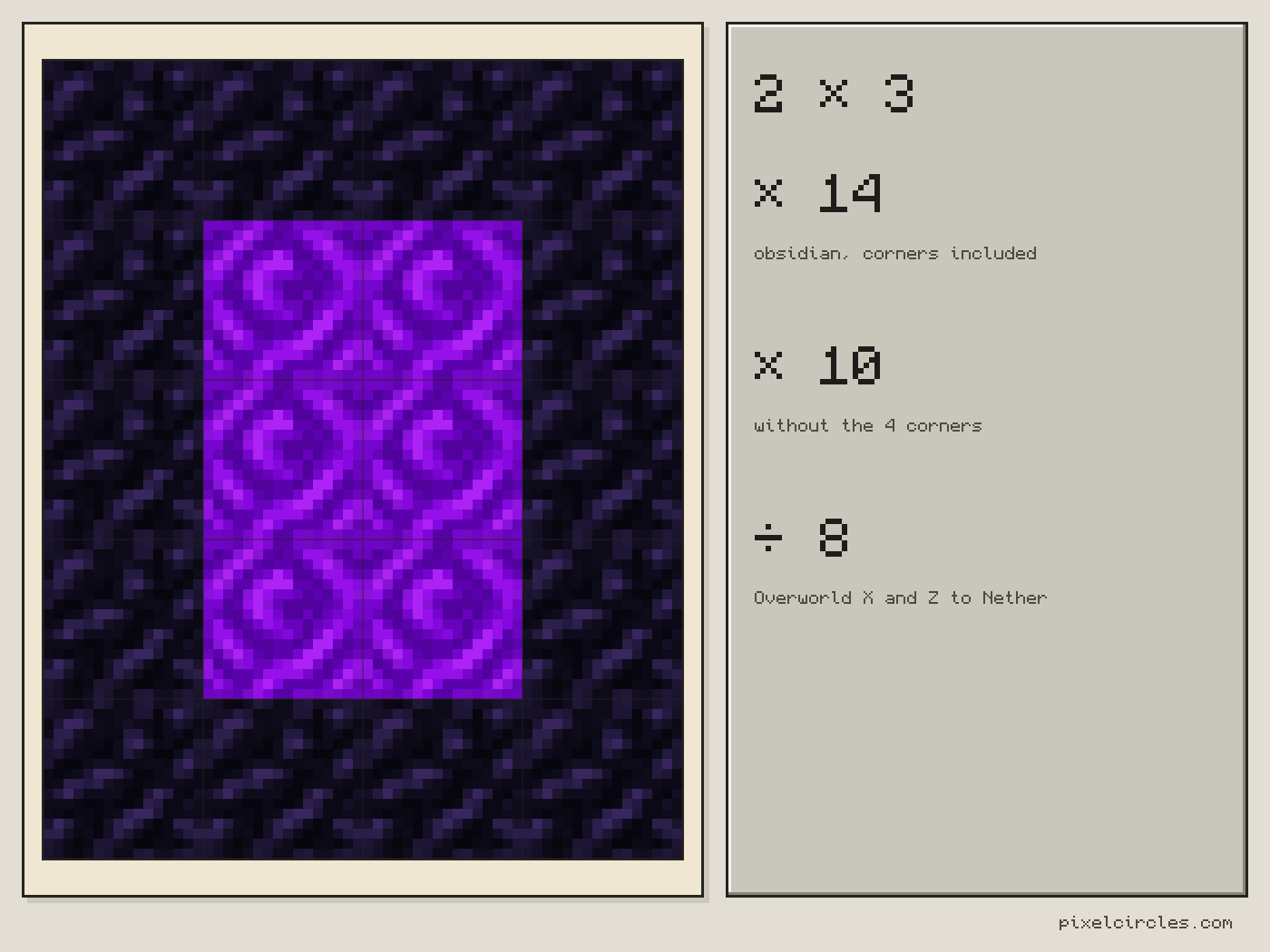
4 × 5 outside, 2 × 3 inside
- Overworld
- 1,000, 64, -2,000
- Nether
- 125, 64, -250
- Obsidian
- 14
- Stacks of 64
- 14 blocks
- Outside size
- 4 × 5
- Portal blocks
- 6
Type in either box: the other side updates. Y is not scaled. Nether X and Z are the Overworld ones divided by 8 and rounded down.
Keys: ↑↓ opening height · E tools
The four corner blocks of the frame are not needed for the portal to light. For the Litematica mod: put the file in .minecraft/schematics, press M in game, then Load Schematics. The file stands the frame up as a wall one block thick.
How to use
- Type coordinates on either side; the other side follows.
- Set the frame opening width and height.
- Download the .litematic, or copy the result.
This Minecraft nether portal calculator turns Overworld coordinates into Nether coordinates and back, then sizes the obsidian frame. Type in either coordinate box and the other one updates. Set the width and height of the opening to see the frame drawn block by block.
How the nether portal calculator converts coordinates
The Nether is eight times smaller than the Overworld along X and Z. One block in the Nether covers eight in the Overworld, so a short walk in the Nether crosses a long way above. The nether portal calculator divides each Overworld horizontal coordinate by 8 and rounds down to get the Nether ones, and multiplies each Nether one by 8 to go back. Y is not scaled, so a portal at Y 64 stays at Y 64.
Rounding down means negative numbers go one block further from zero than you might expect: Overworld X −1 is Nether X −1, and Overworld X −9 is Nether X −2. It also means eight Overworld blocks share every Nether block. Nether X 125 covers Overworld X 1000 to 1007, and the calculator prints that range under the boxes.
Bedrock and Java use the same 1:8 ratio, so this Overworld to Nether calculator works in both. Coordinates past the world border are put on the border, and Nether coordinates stop at ±3,749,998, because eight times more would leave the world.
Overworld to Nether coordinate table
The table shows how Overworld numbers turn into Nether ones, including the rounding of negative numbers. Every value comes from the same conversion as the boxes above.
| Overworld X or Z | Nether X or Z |
|---|---|
| -9 | -2 |
| -8 | -1 |
| -1 | -1 |
| 0 | 0 |
| 7 | 0 |
| 8 | 1 |
| 100 | 12 |
| 1,000 | 125 |
| 5,000 | 625 |
| 10,000 | 1,250 |
How many obsidian blocks a Nether portal needs
The nether portal calculator sizes the frame too. A Nether portal is a rectangle of obsidian with an empty opening inside. Java Edition has allowed frames from 4 × 5 to 23 × 23 blocks since snapshot 13w37a, and Bedrock Edition lists the same limits. Those numbers count the frame from the outside, so the opening is from 2 × 3 to 21 × 21. The four corner blocks of the frame are not needed for the portal to light, although portals the game generates always have them.
The obsidian count is 2 × (width + height) + 4 with the corners, or 2 × (width + height) without, where width and height are the opening. The smallest frame takes 14 obsidian, or 10 without corners. A 10 × 10 opening takes 44, and the biggest possible frame takes 88. Portal blocks fill the opening, so a 2 × 3 opening holds 6.
Choose the size with the width and height boxes and switch the corners on or off. The drawing shows which blocks to place, and the .litematic button gives you the frame as a wall for Litematica.
Obsidian needed for each frame size
The table lists popular frame sizes with the outside size, the obsidian with and without corners, the portal blocks and the number of stacks of 64. Click an opening size to load it into the tool.
| Opening (W × H) | Outside size | Obsidian with corners | Obsidian without corners | Portal blocks | Stacks of 64 (with corners) |
|---|---|---|---|---|---|
| 2 × 3 | 4 × 5 | 14 | 10 | 6 | 14 blocks |
| 3 × 4 | 5 × 6 | 18 | 14 | 12 | 18 blocks |
| 4 × 5 | 6 × 7 | 22 | 18 | 20 | 22 blocks |
| 5 × 5 | 7 × 7 | 24 | 20 | 25 | 24 blocks |
| 6 × 6 | 8 × 8 | 28 | 24 | 36 | 28 blocks |
| 8 × 8 | 10 × 10 | 36 | 32 | 64 | 36 blocks |
| 10 × 10 | 12 × 12 | 44 | 40 | 100 | 44 blocks |
| 15 × 15 | 17 × 17 | 64 | 60 | 225 | 1 stack |
| 21 × 21 | 23 × 23 | 88 | 84 | 441 | 1 stack + 24 |
How far apart do two portals link?
When you step into a portal, the game converts your position as above and looks for a portal near it in the other dimension. In Java Edition the search reaches 128 blocks around the converted position in the Overworld and 16 blocks in the Nether; the Nether range was cut from 128 to 16 in Java 1.16.2 (snapshot 20w28a) to match the 1:8 scale. In Bedrock Edition the search reaches 128 blocks in both dimensions. The search covers the full height of the world.
If several portals are in range, the game picks the closest one by straight-line distance, and the height counts, so a portal that looks further away on the map can win. If there is none, the game builds a new portal within 16 blocks of the converted position. This is why a Nether portal built at the converted coordinates is the safest way to make a link you can predict, and why a nether coordinate calculator like this one is the first tool for a portal network.
A portal built in the Nether that is wider than 18 blocks connects each end to a different Overworld portal.
Nether travel: blocks walked and blocks covered
The Nether is the classic shortcut. This table shows how far the same walk takes you in the Overworld.
| Blocks walked in the Nether | Overworld blocks covered |
|---|---|
| 10 | 80 |
| 50 | 400 |
| 100 | 800 |
| 500 | 4,000 |
| 1,000 | 8,000 |
| 4,000 | 32,000 |
Ideas for a Minecraft nether portal calculator
- Nether highways. Build a portal near your base, note its Nether coordinates and build a second portal near a far-off Overworld target. A 1,000-block trip is a walk of 125 blocks in the Nether.
- Base hubs. Give every base a portal at coordinates that are multiples of 8 so the Overworld and Nether positions line up exactly.
- Farms and spawners. Put a portal next to a farm and write both coordinate sets down, so you can always find your way back.
- Big gates. A 21 × 21 opening is a spectacular gate, at the price of 88 obsidian, which is one stack and 24 blocks.
Tips for the nether portal calculator
Use the coordinates from the F3 screen and type them as they are; decimals are fine, and the calculator rounds down like the game does. When you lay out a portal network, write both coordinate sets down and check with this nether portal calculator that no two Nether portals are close enough to be picked instead of each other. Adjacent portals can share obsidian, which saves blocks.
Frequently asked questions
How do I calculate Nether portal coordinates?
Divide the Overworld horizontal coordinates by 8 and round down; leave Y as it is. Overworld 1000, 64, −2000 becomes Nether 125, 64, −250. Build your Nether portal at that spot and the two portals will link.
How do I convert Nether coordinates to Overworld coordinates?
Multiply the Nether horizontal coordinates by 8 and keep Y. Nether 125, 64, −250 is Overworld 1,000, 64, −2,000. The eight Overworld blocks from that number up to 7 more all lead back to the same Nether block.
How many obsidian blocks do I need for a Nether portal?
The smallest frame, 4 × 5 outside with a 2 × 3 opening, takes 14 obsidian with its corners or 10 without. Larger frames take 2 × (width + height) + 4, up to 88 for the 23 × 23 maximum.
Can the nether portal calculator find where to build the second portal?
Yes. Type the coordinates of the first portal into the Overworld box and read the Nether coordinates: build the second portal there, and the two will link. The calculator also prints the eight-block Overworld area that leads to the same Nether block.
What is the biggest and smallest Nether portal?
The frame is 4 × 5 blocks at the smallest and 23 × 23 at the largest, measured outside. The openings are 2 × 3 and 21 × 21. Both editions use the same limits.
Does the Minecraft nether portal calculator work on Bedrock?
Yes. The 1:8 ratio, the frame sizes and the obsidian counts are the same. Only the portal search range differs: 128 blocks in both dimensions on Bedrock, 128 in the Overworld and 16 in the Nether on Java.
Do I need the corner blocks of the frame?
No. The portal lights without the four corners, so a frame takes 4 fewer obsidian blocks. Portals that the game generates always include them.
Does Y change when I go through a portal?
No. Only the horizontal coordinates are scaled by 8. The game searches the whole height of the world for a portal near the converted position.
Can I build the frame in Litematica?
Yes. Press .litematic in the tools, put the file in .minecraft/schematics, press M in the game and load it. The frame is a wall of obsidian one block thick, with the opening left empty.
Can I import this build straight into Minecraft?
Yes, on Java Edition with the Litematica mod. Install Fabric and MaLiLib, put the .litematic file in .minecraft/schematics, then press M → Load Schematics in Minecraft. In survival, the build appears as a translucent hologram and you place blocks over it; Easy Place can place one block at a time from the projection. In creative, Litematica can paste the whole build into your world; on a server you need administrator (op) permission. Bedrock Edition cannot use .litematic files, so follow the grid and layer plans instead.